


Microsoft Loop, Microsoft's collaboration platform that provides an efficient solution for the digital workplace by enabling real-time collaboration and cross-application collaboration.
In this blog post, you can find out more about Microsoft Loop - an innovative collaboration platform from Microsoft that has been available as a public preview since March 2023.
Learn how Loop enables users to collaborate on workspaces and pages in real time and across multiple applications. The existing functions of the Public Preview are presented and the possibilities of implementation in your organization are shown.
In addition, various use cases are highlighted where Microsoft Loop provides a flexible and collaborative environment for businesses. Read on to find out when and how you can use Loop effectively to optimize your workflows.

Introduction
Microsoft Loop is a collaboration platform from Microsoft that has been available as a public preview since March 2023. The Loop application is designed to enable users to work together collaboratively in workspaces and on websites. This is made possible by the Loop components in real time and across applications.
In June 2023, Microsoft Loop is in the public preview phase. This means that the application and some of its functions can already be used by business and private users, although the platform is still under development.
Existing functions (preview)
Available in the public preview of Microsoft Loop:
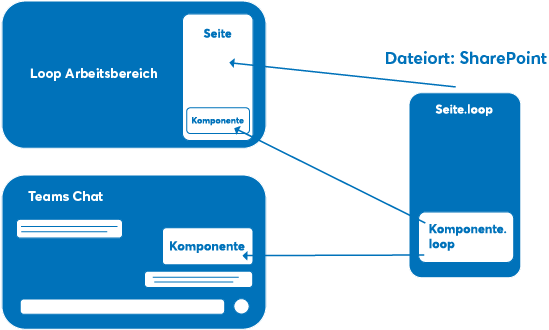
- Loop components: Live content that works in the following M365 applications:
- Teams
- Outlook
- Word (web version)
- Loop pages: Documents for collaboration on loop components
- Loop workspaces: Organization of related loop pages in different groups or sections
- Notifications in the loop interface: The user is notified about mentions and tags.
Microsoft Loop - Setup in the organization
During the preview phase of Microsoft Loop (as of June 2023), anyone with a license for Exchange Online can use the platform and its functions.
Loop features can be enabled across the organization and by implementing Microsoft Loop you can improve collaboration and efficiency in your business.
This white paper explains the necessary steps, best practices and tips for a successful implementation.

Use cases
Microsoft Loop offers a flexible and collaborative environment for specific use cases in companies. When deciding whether to use Microsoft Loop or another Microsoft 365 product, the specific requirements and functional scope of the respective tools must be taken into account.
In principle, Loop should be used for internal tasks where the focus is on flexible collaboration - "fast and creative", but effective collaboration.
Meeting Agenda
Microsoft Teams offers the option of adding an agenda to a meeting as a loop component. Thanks to the possibility of real-time collaboration, changes and additions can be made by all participants.
This facilitates the management and visibility of the agenda. The integrated "Agenda" area of Teams Meetings shows participants where the agenda can be found.
Meeting notes
Meeting participants can save their notes in a loop component and share them with others after the meeting.
Alternatively, Microsoft Teams with its function for creating and sharing documents can also be used.
Depending on the scope and layout of the notes, consider whether Microsoft Loop is the best option, as other products such as Microsoft OneNote may offer more specific features for capturing and organizing meeting notes.
Brainstorming
Microsoft Loop offers a suitable environment for joint brainstorming. Participants can record their ideas in a shared document and discuss and develop them in real time.
In combination with Loop components, Microsoft Whiteboard can also be used to visually capture and discuss ideas. The Loop page serves as the primary point of contact and the function of sharing components across Microsoft 365 apps can enable integrations such as with Whiteboard.
In this use case, the asynchronous collaboration possible with Loop through real-time updates and comment functions in the components can in some cases replace and simplify the alternative workflow of a team meeting with joint editing of a OneNote.
Team decision
Microsoft Loop offers a template for the joint creation and documentation of team decisions. The team can work together on a document and discuss various options and arguments.
The commenting functionality and tagging of employees enable an asynchronous way of working instead of or in combination with a meeting.
When should I use Loop?
If you already have defined processes and tools in your company for planning and documenting projects, orders, etc., do not see Loop as a replacement for the complete system, but as a supplement in some suitable use cases.
You can identify these use cases by asking yourself the following questions:
- Do several employees have to work on this content simultaneously / asynchronously?
- Is this content a tool for the creation process or the product of the creation process? - For tools - Loop components could optimize the creation process here?
- For products - The results should be recorded in a less dynamic form, the answer could therefore lie more in classic Office products such as Word etc.
Conclusion
The analysis has shown that Loop is suitable for use cases where a fast and dynamic collaborative solution is needed for taking notes or sharing information and opinions.
Although the components are therefore suitable for such use cases due to their real-time updating, classic Office products such as Word and PowerPoint should still be selected for saving results due to their far greater range of functions and lower dynamics.
In practice, the success of Microsoft Loop depends heavily on the individual implementation and customization that each company must undertake in order to use the product effectively. It is important that companies consider their specific requirements and workflows to ensure that Microsoft Loop actually adds value to their organization.
